
Cashback Portals vs. Coupon Sites: Two Very Different Paths to Savings

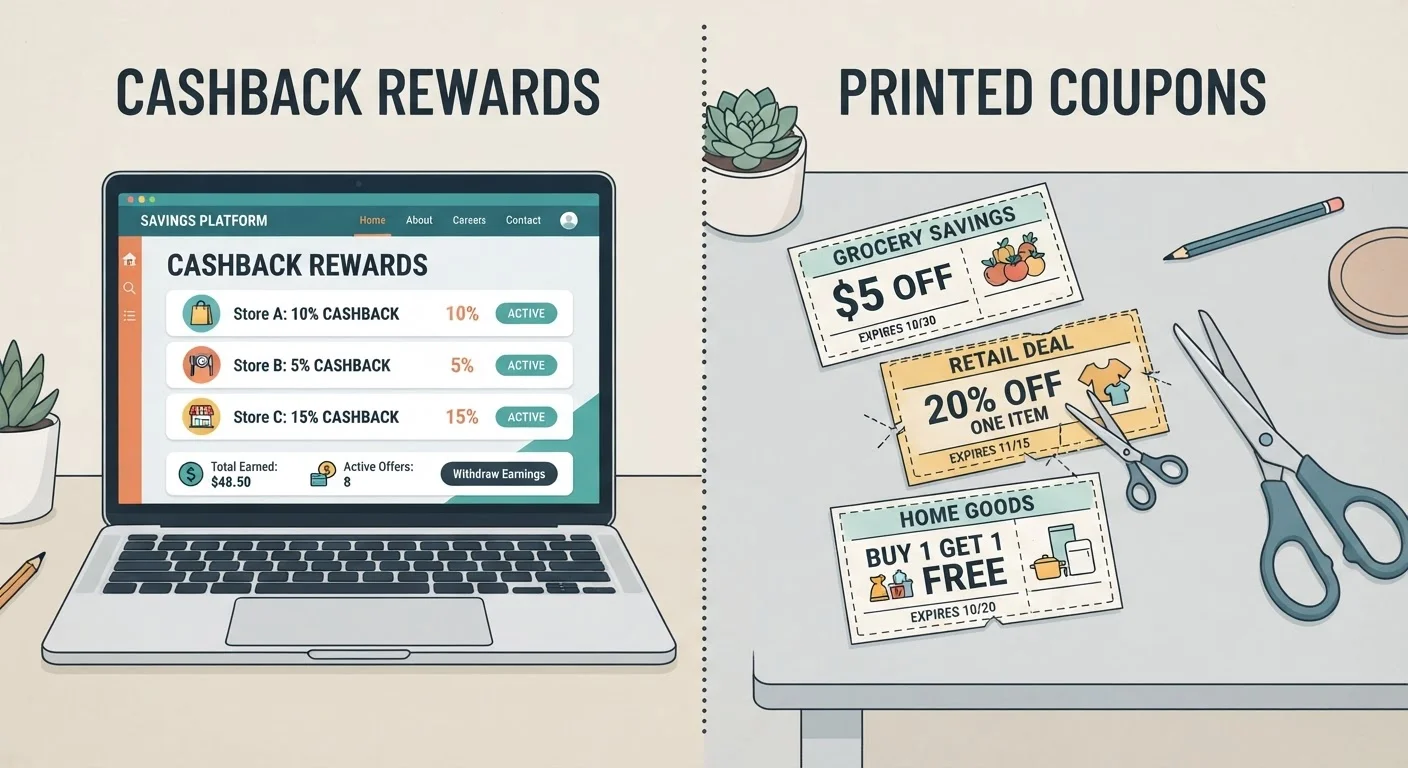
Photo: efficientlifeguide.net editorial
Key Takeaways
- Cashback portals pay you after a purchase is verified, typically within days or weeks.
- Coupon sites provide codes or printable coupons that reduce the price at the point of sale.
- The two tools can often be used together on the same transaction when a retailer allows both.
- Cashback rates fluctuate and are not guaranteed; always confirm the current rate before shopping.
- Coupon codes expire and may have minimum purchase requirements or category exclusions.
- Neither tool replaces comparing base prices: a discount on an inflated price may still be a poor deal.
How each tool actually works
Cashback portals sit between you and the retailer. When you click through a portal to a store's website, the portal earns a referral commission from that retailer. It then shares a portion of that commission with you as cashback, credited to your portal account. The saving is calculated as a percentage of your purchase total and paid out after the retailer confirms the order, usually after the return window closes.
Coupon sites work differently. They collect discount codes, printable coupons, and promotional offers from retailers and manufacturers, then publish them in a searchable database. You find a code, copy it, and enter it at checkout to reduce your total immediately. Printable versions work at physical registers. The saving is fixed at checkout; there is no waiting period and no portal account to manage.
Understanding these mechanics matters because they affect timing, reliability, and which purchases each tool suits. For a broader look at how discounts, rebates, and promo codes differ from one another, see what discounts, coupons, and sales actually mean.
Side-by-side comparison
The table below covers the practical differences families encounter most often.
| Criterion | Cashback Portals | Coupon Sites |
|---|---|---|
| When you receive the saving | After order is verified (days to weeks) | Immediately at checkout |
| Saving format | Percentage of purchase total | Fixed code, dollar amount, or percentage |
| Account required | Yes, to accumulate and withdraw cashback | Usually no; codes are often publicly listed |
| Works in-store | Rarely; mostly online purchases | Yes, with printable or app-based coupons |
| Code expiry risk | Rate may change; no code to expire | Codes expire; database may be outdated |
| Can be combined | Sometimes, depending on retailer terms | Sometimes, depending on retailer terms |
| Best purchase types | Online retail, travel, subscriptions | Grocery, apparel, online and in-store retail |
One detail worth noting: coupon sites often aggregate codes submitted by users, which means a listed code may already be expired or restricted to new customers. Verifying a code works before completing a purchase is worth the extra few seconds.
When the two tools overlap
Some retailers allow both a coupon code and portal cashback on the same order, which makes the combination worth attempting on larger purchases. The process is straightforward: activate the portal first, then proceed to the retailer's site and apply the coupon code at checkout. If the portal tracks the order correctly, you receive both the immediate discount and the deferred cashback.
However, some retailers explicitly exclude orders that use promo codes from cashback eligibility. Portal terms vary by retailer, and those exclusions are not always prominently disclosed. Checking the portal's individual retailer terms before shopping prevents a situation where the cashback is voided after purchase.
For families interested in layering multiple savings mechanisms on a single transaction, how combining coupons, rebates, and sales works covers the rules and limits in more detail.
Cashback and coupon code compatibility
Practical limits of each approach
Cashback portals have a real weakness: the cashback rate on any given retailer can change daily, and promotional elevated rates are temporary. A rate advertised when you first sign up may not exist by the time you shop. Payout thresholds also apply; most portals require you to accumulate a minimum balance before withdrawing, which can take time for infrequent shoppers.
Coupon sites have their own friction. Code databases go stale quickly, and sites that rely on user-submitted codes have no systematic way to remove invalid entries. Some published codes apply only to specific product categories, minimum cart sizes, or first-time purchases. Families who rely on coupon sites for grocery savings will find that in-store manufacturer coupons have different distribution channels than online codes. Where grocery coupons actually come from explains those channels in practical terms.
Both tools share a fundamental limit: neither guarantees the base price is competitive. Using a coupon or activating cashback on an overpriced item still leaves you paying more than a lower headline price elsewhere. Comparing base prices before applying any discount remains the first step. Deal-finding habits that hold up over time addresses how to build that comparison into a routine.
This article is for general informational purposes only and does not constitute financial or purchasing advice. Cashback rates, coupon availability, and retailer terms change frequently. Verify current terms directly with any portal or retailer before making a purchase decision.
The content provided on our blog site traverses numerous categories, offering readers valuable and practical information. Readers can use the editorial team’s research and data to gain more insights into their topics of interest. However, they are requested not to treat the articles as conclusive. The website team cannot be held responsible for differences in data or inaccuracies found across other platforms. Please also note that the site might also miss out on various schemes and offers available that the readers may find more beneficial than the ones we cover.