
The Anatomy of a Good Deal: What Discounts, Coupons, and Sales Actually Mean

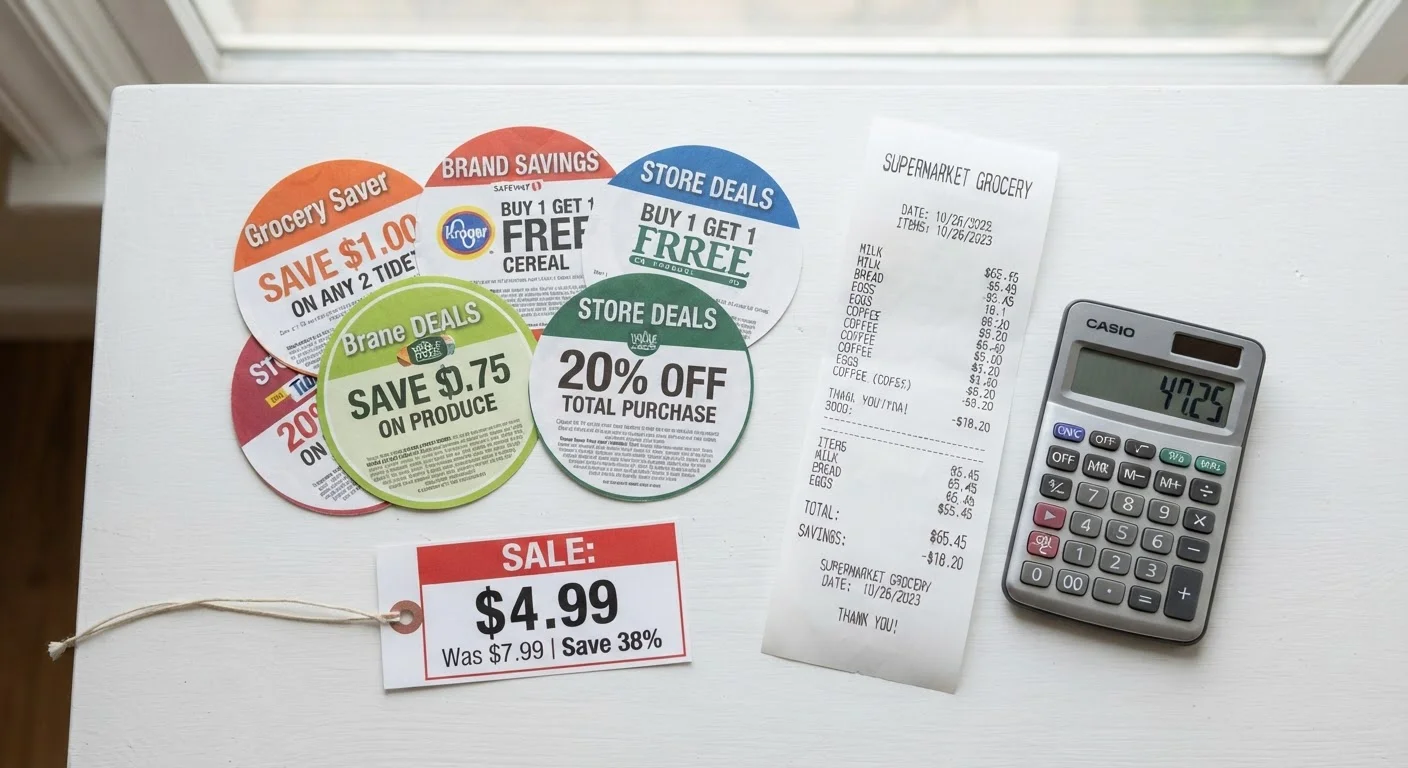
Photo: efficientlifeguide.net editorial
Key Takeaways
- A sale reduces the shelf price automatically; a coupon requires you to present or enter a code to receive savings.
- Rebates return money after purchase, meaning you pay full price upfront and wait for reimbursement.
- Promo codes are digital coupons that function identically to paper coupons but apply at online checkout.
- Clearance pricing reflects a permanent markdown on remaining inventory, not a temporary promotional event.
- Understanding which savings type applies lets you plan purchases more accurately and avoid inflated 'original' prices.
Why the terminology matters before you shop
Most families encounter a mix of sales tags, coupon apps, rebate offers, and promo codes every week, often without a clear sense of how each one works. The differences are not trivial. Using the wrong savings mechanism, or misreading a tag, can lead to paying more than necessary or missing a genuine reduction entirely.
Getting the vocabulary straight also protects you from one of retail's most persistent tricks: the inflated 'original' price. When you understand what a sale actually requires versus what a coupon requires, you are better placed to judge whether a posted discount is real. For families building consistent savings habits, that foundation matters. Our beginner's guide to deal hunting covers how to build those routines from scratch.
Sales, markdowns, and clearance: how store-initiated reductions work
A sale is a temporary price reduction that a retailer sets on one or more products, usually for a defined window. No action is required from you beyond shopping during the period. The price reverts when the promotion ends.
A markdown is structurally similar but often less formal. Retailers use it to describe a price reduction that may persist indefinitely until inventory is depleted. Clearance is the most permanent of the three: it signals that remaining stock is being sold below the regular price because the item will not be restocked. Clearance prices do not rebound to the original level.
Timing purchases around predictable markdown cycles is a practical way to extend a grocery or household budget. Major categories follow seasonal patterns, and our seasonal discount calendar maps those cycles by product type.
Over 90%
Of U.S. shoppers who use coupons or discounts
According to Statista consumer surveys, a large majority of American shoppers report using some form of coupon or discount offer during their shopping.
30-40%
Of mail-in rebates that go unredeemed
Industry estimates have consistently suggested that a significant share of issued rebates are never submitted by consumers, benefiting retailers and manufacturers.
Billions annually
In unclaimed rebate value in the U.S.
Consumer advocacy groups have noted that unredeemed rebates represent substantial value that shoppers pay for but do not collect each year.
Coupons, promo codes, and how conditional discounts work
A coupon is a discount instrument you must actively present or apply. Without it, you pay the shelf price even if you are buying exactly the right product. Paper coupons come from manufacturers or retailers. Digital coupons live in apps or are clipped to a loyalty account. Promo codes are the online equivalent: alphanumeric strings entered at checkout that trigger the same conditional reduction.
One important distinction is who issues the coupon. Manufacturer coupons are funded by the brand and accepted at most retailers that carry the product. Store coupons are issued and funded by the retailer and are only valid at that chain. This distinction matters when you are trying to layer savings, which our article on stacking discounts addresses in full.
Promo codes vary in scope. Some apply a flat dollar amount off an order, others give a percentage reduction, and some unlock free shipping. Reading the terms before checkout prevents surprises about minimum order thresholds or category exclusions.
Rebates and cashback: money that comes after the purchase
Rebates and cashback both return money to you after the transaction, but they operate through different channels. A traditional rebate, including the mail-in variety once common with electronics, requires you to submit proof of purchase within a deadline. The manufacturer sends a check or prepaid card weeks later. Instant rebates work differently: the reduction applies at the register without any submission, functioning more like a coupon in practice.
Cashback programs, whether through a credit card or a dedicated portal, track your purchase and credit a portion of the amount back to your account. There is usually no manual claim involved, though portals require you to initiate your shopping session through their link. For a clear comparison of how portal cashback and coupon sites differ, see our piece on cashback portals vs. coupon sites.
The main risk with any post-purchase return mechanism is execution. Missed deadlines, forgotten submissions, and portal tracking failures all reduce the actual savings received.
A grocery store advertises chicken breast at 30% off for the week. No coupon is needed; the reduced price appears automatically at checkout.
A shopper clips a digital coupon in a supermarket app for $1.50 off a specific cereal brand, then buys that cereal during a week when it is also on sale for 20% off.
A family buys a vacuum cleaner at full price and mails in a $40 rebate form from the manufacturer within 30 days of purchase.
Before booking a hotel online, a parent opens a cashback portal, navigates to the booking site through the portal's link, and completes the reservation.
Reading savings claims accurately
Retailers frequently display a 'was' or 'original' price alongside a sale price to communicate the size of a discount. These reference prices are not always verified externally. A product may have carried a higher price for only a short period before the 'sale' began, making the percentage discount appear larger than it represents in practice.
Price-tracking tools, available as browser extensions or standalone sites, log historical prices and show whether the current sale price is a genuine low or a common price dressed up as a discount. Checking price history takes under a minute for most products and removes guesswork from the decision.
Families who build this habit alongside understanding the savings terminology above tend to make more confident purchase decisions. For further strategies that hold up across weeks and months, see our article on deal-finding habits that hold up over time.
Frequently Asked Questions
The content provided on our blog site traverses numerous categories, offering readers valuable and practical information. Readers can use the editorial team’s research and data to gain more insights into their topics of interest. However, they are requested not to treat the articles as conclusive. The website team cannot be held responsible for differences in data or inaccuracies found across other platforms. Please also note that the site might also miss out on various schemes and offers available that the readers may find more beneficial than the ones we cover.