
Bulk Buying: When Stocking Up Saves Money and When It Wastes It

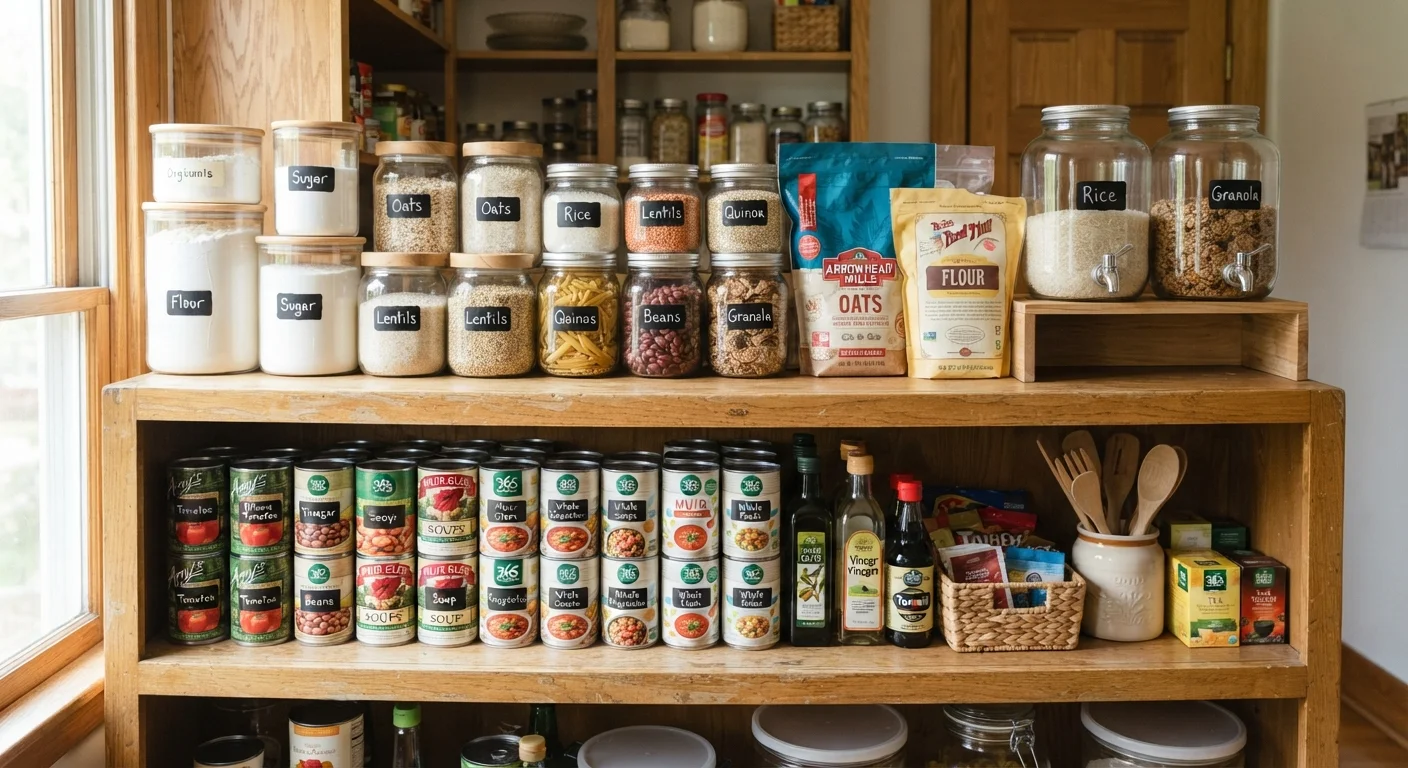
Photo: efficientlifeguide.net editorial
Key Takeaways
- Unit price is the only reliable measure of whether a bulk purchase actually saves money.
- Perishable items bought in bulk often create waste that erases any price advantage.
- Upfront cost and storage space are real constraints that bulk buying can strain.
- Non-perishable staples your household uses regularly are the strongest candidates for bulk buying.
- Splitting bulk quantities with another household can capture the savings without the waste risk.
Lower cost per unit on non-perishable goods
Buying larger quantities of shelf-stable items such as rice, canned goods, or cleaning supplies typically reduces the per-unit cost by a meaningful margin, often 20 percent or more compared to standard retail sizes.
Fewer shopping trips over time
Stocking up on household staples means you run out less often, which cuts the time and fuel cost of routine store runs and reduces the chance of impulse purchases during unplanned trips.
Protection against price increases
Buying ahead at today's price means a short-term rise in the cost of a staple does not affect your household until your supply runs out, acting as a simple form of price stability.
Works well with batch cooking and meal prep
Large quantities of dry staples or proteins support batch cooking sessions, where you prepare multiple meals at once and reduce the per-serving cost of each meal.
Perishable items often spoil before use
Fresh produce, dairy, and bakery items bought in large quantities frequently go bad before a household finishes them, turning a cheap unit price into an actual loss once wasted food is counted.
Large upfront cost strains monthly cash flow
A bulk purchase might save $20 over time but require $90 today, which can create budget pressure in the current pay period even when the long-term math is favorable.
Storage space is a real and often underestimated constraint
Large quantities of paper products, canned goods, or bottled liquids require pantry, closet, or garage space that many apartments and smaller homes simply do not have.
Abundance effect increases consumption rate
Research in consumer behavior suggests people tend to use products faster when they perceive a large supply on hand, which can eliminate the intended savings on items like snacks, toiletries, or beverages.
Impulse bulk purchases often go unused
Warehouse store environments are designed to make large quantities feel like obvious deals, but items your household uses infrequently will sit in storage and eventually be discarded rather than generating savings.
What bulk buying actually means for your budget
Buying in bulk means purchasing larger quantities of a product at one time, usually at a lower cost per unit than smaller packages. The appeal is straightforward: pay less per ounce, per roll, or per serving. However, the math only works in your favor when the product gets used before it expires, spoils, or becomes unwanted.
The first number to check is the unit price, not the package price. Many grocery stores print unit price (cost per ounce, per count, or per sheet) on the shelf label. If yours does not, divide the total price by the number of units. A 50-count box of trash bags at $12.00 costs $0.24 per bag. A 20-count box at $6.00 costs $0.30 per bag. The bulk option saves $0.06 per bag, or $3.00 over the same number of bags. That is real savings, but only if you actually use all 50 bags.
For more strategies on trimming regular grocery spending, see practical grocery-saving techniques that work alongside bulk purchasing.
Lower cost per unit on non-perishable goods
Buying larger quantities of shelf-stable items such as rice, canned goods, or cleaning supplies typically reduces the per-unit cost by a meaningful margin, often 20 percent or more compared to standard retail sizes.
Fewer shopping trips over time
Stocking up on household staples means you run out less often, which cuts the time and fuel cost of routine store runs and reduces the chance of impulse purchases during unplanned trips.
Protection against price increases
Buying ahead at today's price means a short-term rise in the cost of a staple does not affect your household until your supply runs out, acting as a simple form of price stability.
Works well with batch cooking and meal prep
Large quantities of dry staples or proteins support batch cooking sessions, where you prepare multiple meals at once and reduce the per-serving cost of each meal.
When stocking up genuinely saves money
Bulk buying performs well in a narrow but reliable set of circumstances. The product must be non-perishable or have a long shelf life. Your household must use it at a predictable rate. You must have somewhere to put it. And the upfront cash must be available without pushing other bills.
Dry staples such as rice, dried lentils, oats, and pasta are textbook bulk candidates. They store for a year or more in sealed containers, most families consume them regularly, and the per-pound price drop at larger quantities is often 20 to 40 percent. Household consumables like paper towels, dish soap, and laundry detergent follow similar logic. They do not expire quickly, and usage is consistent month to month.
Freezer capacity changes the calculus for meat and bread. Buying a larger portion of ground beef or chicken when it is on sale and freezing it in meal-sized portions can cut per-serving cost considerably. Batch cooking pairs naturally with this approach, since you can process and freeze large quantities in one session rather than cooking daily.
When bulk buying wastes money
The savings calculation collapses the moment product goes unused. Fresh produce bought in large bags often rots before a small household finishes it. Specialty items purchased in bulk because the unit price looked good sit in the pantry untouched. Warehouse store quantities of snack foods get eaten faster than normal because the supply feels endless, a pattern sometimes called the abundance effect.
Bulk buying can also strain cash flow. Spending $80 on a case of canned tomatoes might save $15 over buying them individually, but if that $80 comes out of a week's grocery budget, it may force compromises elsewhere. That hidden cost rarely appears in the unit-price comparison.
Perishable items often spoil before use
Fresh produce, dairy, and bakery items bought in large quantities frequently go bad before a household finishes them, turning a cheap unit price into an actual loss once wasted food is counted.
Large upfront cost strains monthly cash flow
A bulk purchase might save $20 over time but require $90 today, which can create budget pressure in the current pay period even when the long-term math is favorable.
Storage space is a real and often underestimated constraint
Large quantities of paper products, canned goods, or bottled liquids require pantry, closet, or garage space that many apartments and smaller homes simply do not have.
Abundance effect increases consumption rate
Research in consumer behavior suggests people tend to use products faster when they perceive a large supply on hand, which can eliminate the intended savings on items like snacks, toiletries, or beverages.
Impulse bulk purchases often go unused
Warehouse store environments are designed to make large quantities feel like obvious deals, but items your household uses infrequently will sit in storage and eventually be discarded rather than generating savings.
Impulse bulk purchases are another common trap. A product that looks like an extraordinary deal in a warehouse store may be something your family uses only occasionally. The pantry staples that quietly inflate grocery bills are often the same items that seem like smart bulk buys at the time of purchase.
Practical rules before committing to a bulk purchase
Before adding a large quantity to your cart, run through four questions. First, what is the unit price compared to a standard size? Second, how long before this expires or goes stale? Third, does your household have realistic storage for this quantity? Fourth, will buying this many actually change how quickly you consume it?
If the answer to any of those is unfavorable, the purchase likely does not save money in practice. A useful middle ground is splitting bulk quantities with a neighbor or family member. Both households get the lower unit price without the storage burden or the spoilage risk. This works especially well for fresh items like a large bag of onions or a flat of eggs.
~30%
Average household food waste by weight
The U.S. Department of Agriculture has estimated that American households waste roughly 30 percent of the food they purchase, a figure that bulk buying of perishables can worsen.
20-40%
Typical unit-price reduction on dry staples
Consumer budget analyses generally find that buying shelf-stable staples like rice, oats, and pasta in larger quantities reduces the per-unit cost by 20 to 40 percent compared to standard retail packages.
Tracking what you buy and what you waste for a month before committing to bulk purchasing gives you real data about your household's consumption patterns rather than estimates. The family grocery budget strategies that work best are always built on accurate records of actual spending and usage, not assumptions.
This article is for general informational purposes only and does not constitute financial or purchasing advice tailored to your specific household circumstances. Consult your own budget and financial situation before making significant purchasing decisions.
The content provided on our blog site traverses numerous categories, offering readers valuable and practical information. Readers can use the editorial team’s research and data to gain more insights into their topics of interest. However, they are requested not to treat the articles as conclusive. The website team cannot be held responsible for differences in data or inaccuracies found across other platforms. Please also note that the site might also miss out on various schemes and offers available that the readers may find more beneficial than the ones we cover.