
Room by Room: Where Your Household Budget Actually Goes

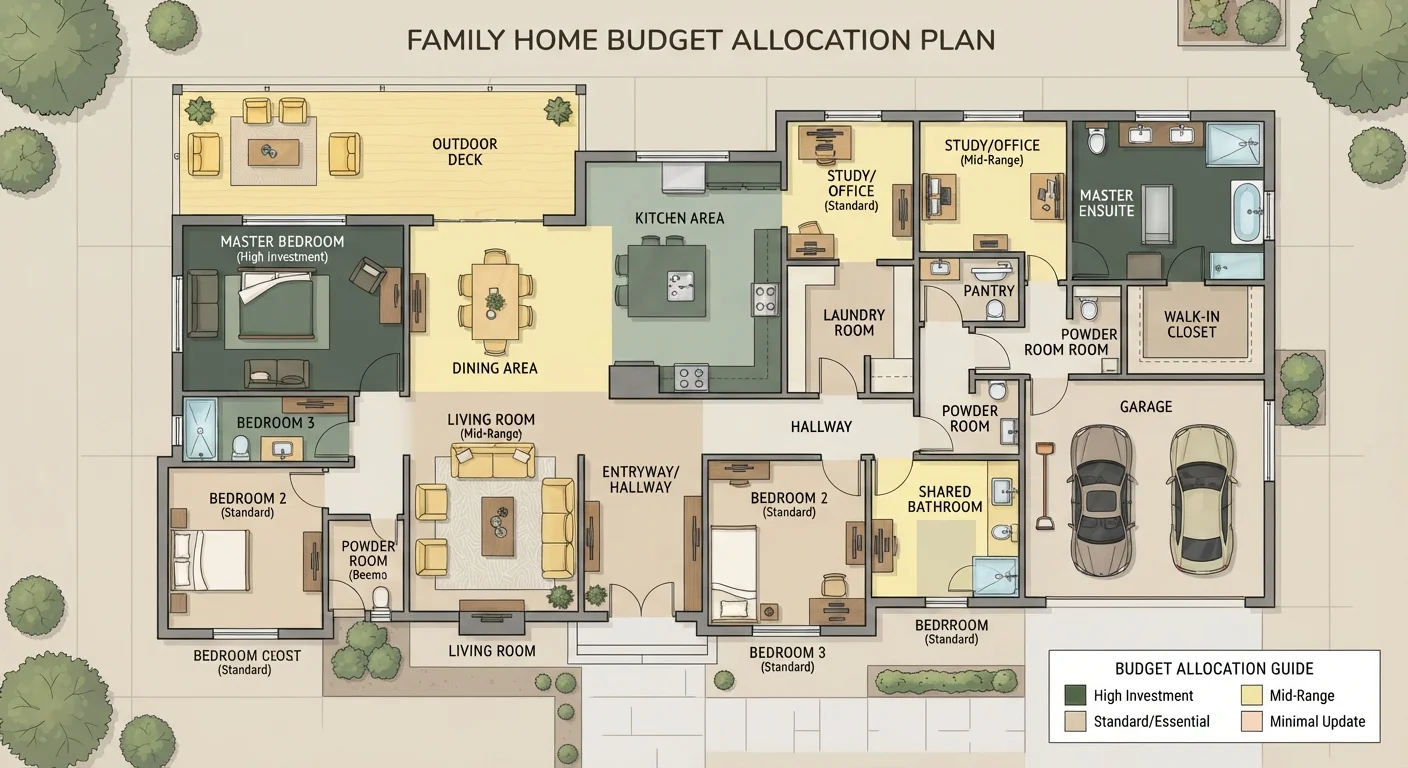
Photo: efficientlifeguide.net editorial
Why a room-by-room view changes how you budget
Most families track spending by category: groceries, utilities, insurance. That approach works for taxes and reports, but it hides something useful. When you map costs to the physical spaces in your home, the biggest drains become obvious in a way that spreadsheet categories rarely reveal.
This article walks through each major area of the home, names the costs that live there, and points to where real savings are possible. It is general financial information, not advice tailored to your specific situation. For decisions about your household finances, a qualified financial adviser or accountant can help.
If you want a structured way to apply what you find here, the monthly budget audit checklist walks through every spending category room by room.
| Share of home energy used by heating and cooling | ~50% (U.S. Department of Energy) |
| Common maintenance reserve guideline | 1% of home value per year (General personal finance planning benchmark) |
| Typical water heater lifespan | 8 to 12 years (General home maintenance guidance) |
| Older refrigerator energy use vs. current models | Up to 3x more electricity (General appliance efficiency estimates) |
Kitchen: the room that eats the most
Food costs split into two buckets: groceries and waste. The U.S. Department of Agriculture has estimated that households throw away a significant share of the food they buy, which means a portion of every grocery run goes straight to the trash. Meal planning, portioned buying, and using a freezer aggressively all shrink that waste without changing what you eat.
Appliance energy is the other kitchen cost families underestimate. Older refrigerators, in particular, can draw two to three times the electricity of current models. If your fridge is more than 15 years old, checking its annual energy use against a newer unit is worth the 10 minutes it takes.
The Eat Well Spend Less hub covers budget-friendly meal strategies in detail for families of every size.
Utility rooms and mechanicals: invisible but expensive
The laundry room, water heater, and HVAC system share a trait: they cost money every day and get almost no attention until something breaks. Heating and cooling alone typically account for roughly half of a home's total energy bill, according to the U.S. Department of Energy.
Simple, low-cost steps include sealing gaps around doors and windows, replacing HVAC filters on schedule, and washing laundry in cold water. Each one is small, but together they can cut annual energy costs by a measurable amount. For a deeper look at what goes beyond the thermostat, see the article on heating and cooling your home on less.
Maintenance deferred here almost always costs more later. Water heaters, for instance, typically last 8 to 12 years. Replacing one on your schedule is far less disruptive than replacing one after it fails. The hidden costs of homeownership article covers how to budget for these cycles in advance.
Living spaces: where subscriptions quietly accumulate
The living room and home office rarely carry large line items, but they host a category of spending that grows without much notice: recurring subscriptions. Streaming services, cloud storage, news apps, and software trials often renew monthly with no reminder. Many households pay for services they stopped using months earlier.
A straightforward audit, reviewing every recurring charge on one bank or card statement, typically surfaces several that can be cancelled without any real loss. The article on subscription creep explains a structured approach to finding and trimming these charges.
Bedrooms and bathrooms: consumables and personal care
These rooms carry steady, lower-dollar costs: toiletries, cleaning supplies, linens, and personal care products. Because each purchase is small, families rarely add them up. Over a year, though, personal care and household consumables can represent a meaningful share of discretionary spending.
Buying in bulk when prices are low, choosing store-brand alternatives, and tracking unit prices rather than package prices are the most reliable ways to reduce these costs without downgrading quality. Understanding the difference between fixed and variable expenses helps you see where consumables fit in your overall budget picture.
Repairs and maintenance: the budget category most families skip
No room is immune from repairs, and the cost of ignoring small problems is well documented in home maintenance literature. A slow roof leak, a drafty window frame, or a dripping faucet each becomes more expensive the longer it sits.
A general rule of thumb, used in personal finance planning, is to set aside roughly 1% of your home's value per year for maintenance. That figure varies by home age, condition, and region, so treat it as a starting point rather than a guarantee. See which home expenses catch families off guard for a fuller picture.
Some repairs make sense to handle yourself; others do not. The guide on DIY home repairs versus professional jobs gives a practical framework for deciding which is which.
This article is for general informational purposes only and is not financial or professional advice. Consult a qualified financial adviser or licensed professional for guidance specific to your situation.
The content provided on our blog site traverses numerous categories, offering readers valuable and practical information. Readers can use the editorial team’s research and data to gain more insights into their topics of interest. However, they are requested not to treat the articles as conclusive. The website team cannot be held responsible for differences in data or inaccuracies found across other platforms. Please also note that the site might also miss out on various schemes and offers available that the readers may find more beneficial than the ones we cover.