
Cloth Napkins, Bar Soap, and Other Swaps That Quietly Shrink Household Spending

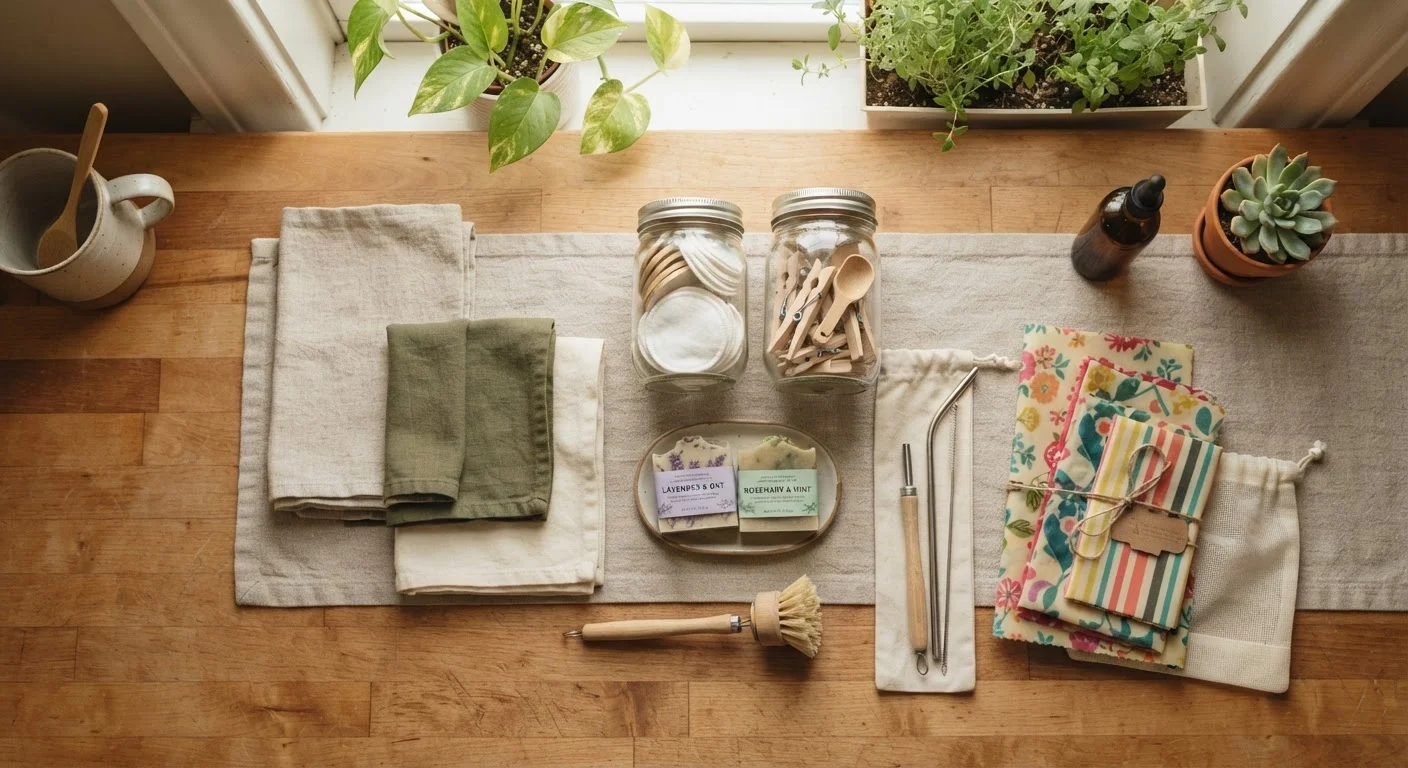
Photo: efficientlifeguide.net editorial
Key Takeaways
- Switching from paper napkins to cloth can save a family of four roughly $100 or more per year.
- Bar soap typically costs less per use than liquid soap and produces less plastic waste.
- Reusable alternatives for disposable items pay for themselves within a few months in most households.
- The highest savings come from targeting items bought most frequently, not the most expensive purchases.
- Most swaps require a small upfront cost but carry no significant trade-off in comfort or convenience.
Why small swaps add up faster than big cuts
Household budgets often get attacked at the top line: cancel a streaming service, shop a different store, clip digital coupons. Those moves matter, and if you want a fuller picture of where your money actually goes by room, the room-by-room budget breakdown is worth reading alongside this. But the spending that quietly compounds month after month is the disposable item category: products bought, used once, thrown away, and bought again.
Paper towels, plastic wrap, single-use soap pumps, dryer sheets, disposable razors. None of these feels expensive on its own. Stacked across a year for a household of three or four people, they represent a surprisingly large line item. The swaps below target that category specifically. Each one has a meaningful per-unit cost difference, requires no special skill, and holds up in daily use.
Start with what you buy most often
Eight swaps worth making
Cloth napkins instead of paper
A family of four that uses two paper napkins per person per day goes through roughly 3,000 napkins a year. A set of 12 to 20 cloth napkins handles the same workload indefinitely with regular washing. The upfront cost is typically recovered within three to four months, and cloth napkins last years with normal laundering. Cotton or linen options hold up better over time than blended fabrics.
A set of cloth napkins recovers its cost in three to four months for most families.
Bar soap instead of liquid pump soap
Bar soap consistently costs less per wash than liquid soap when compared by the number of uses per ounce. Liquid soap also tends to be over-dispensed: a pump releases more than a single handwash requires. Bar soap, by contrast, is self-limiting. It works equally well for handwashing and bathing, and many options are sold with minimal packaging. The switch does not require any change in routine.
Liquid soap is frequently over-dispensed; bar soap is self-limiting by design.
Reusable beeswax or silicone wraps instead of plastic wrap
Plastic wrap is one of the most single-use items in the kitchen. Reusable food wraps made from beeswax-coated cotton or food-grade silicone cover bowls, wrap cut produce, and store leftovers. They are hand-washed and reused. A set of three to five sizes covers most storage needs. Beeswax wraps are not suitable for raw meat or microwave use, so keeping one or two pieces of standard wrap on hand for those cases is practical.
Reusable food wraps handle most kitchen storage tasks and last through hundreds of uses.
Concentrated cleaning solutions instead of pre-diluted sprays
Most spray cleaners sold in retail are 90 percent water. Concentrated versions, sold in small bottles or tablet form, are mixed with tap water at home in a reusable spray bottle. The cost per bottle prepared at home is typically a fraction of the pre-diluted version. The cleaning performance is equivalent when the concentrate is mixed at the manufacturer's recommended ratio. This also reduces plastic bottle consumption substantially over a year.
Most retail spray cleaners are 90 percent water; concentrates cost far less per prepared bottle.
Wool dryer balls instead of dryer sheets
Dryer sheets are bought, used once, and discarded. Wool dryer balls do the same job, reducing static and softening fabric by tumbling through the load, and they last for hundreds of dryer cycles. A set of three to six balls is enough for a standard load. They have no added fragrance, which suits households with skin sensitivities. The per-load cost drops to near zero after the initial purchase.
Wool dryer balls last hundreds of cycles; the per-load cost drops to near zero after purchase.
A safety razor instead of cartridge razors
Cartridge razor heads are among the highest-markup items in the personal care aisle. A double-edge safety razor has a higher upfront cost but uses replacement blades that cost a small fraction of cartridge prices. For adults who shave regularly, the annual savings can be significant. Safety razors require a short learning curve for angle and pressure, but most users adjust within a week or two. The razor handle itself lasts indefinitely with basic rinsing.
Safety razor blades cost a fraction of cartridge replacements, with savings that grow each year.
Washable microfiber cloths instead of paper towels
Paper towels handle spills and surface cleaning, but a stack of washable microfiber cloths does both tasks without the recurring cost. Microfiber picks up grease, dust, and moisture efficiently without cleaning products in many cases. Keeping a dedicated bin for used cloths near the sink makes the routine easy to maintain. Paper towels still have a role for truly messy jobs or raw meat contact, so a partial replacement rather than a full one tends to work best.
Microfiber cloths handle most paper towel tasks and go straight into the laundry for reuse.
Whole-bean or ground coffee brewed at home instead of single-serve pods
Single-serve coffee pods cost several times more per cup than ground or whole-bean coffee brewed in a standard drip machine or French press. For a household that drinks two to three cups per person per day, the difference adds up quickly across a month. The flavor difference is minimal when using fresh coffee, and the brewing process takes the same amount of time. This swap pairs well with a broader look at cutting grocery spending without changing what you eat.
Pods cost several times more per cup than ground coffee brewed in a standard home machine.
If you find yourself adding disposable items to your cart out of habit rather than preference, it is worth running a quick audit. The deal-finding habits that hold up article has a practical framework for evaluating whether a recurring purchase is earning its place in your budget. Recurring subscriptions follow the same logic, and subscription creep covers that angle directly.
Making the transition without friction
The households that stick with these swaps tend to phase them in one at a time rather than replacing everything at once. Start with the item your family uses most often. Once that swap feels normal, add another. Buying multiple cloth napkins or a set of reusable wraps at the start avoids the laundry timing problem that causes people to fall back on disposables.
A few of these swaps also connect to food spending. If you are already thinking about smarter kitchen habits, the pantry staples that run up grocery bills piece looks at a parallel category: items in your pantry that cost more per use than you might expect. The same pattern of high-frequency, low-unit-cost purchases applies in both places.
This article is for general informational purposes only. Individual savings will vary based on household size, usage habits, and local prices. Consult product labels and manufacturer guidance for care and safety instructions.
The content provided on our blog site traverses numerous categories, offering readers valuable and practical information. Readers can use the editorial team’s research and data to gain more insights into their topics of interest. However, they are requested not to treat the articles as conclusive. The website team cannot be held responsible for differences in data or inaccuracies found across other platforms. Please also note that the site might also miss out on various schemes and offers available that the readers may find more beneficial than the ones we cover.